Image - 2026-06-04 19:30
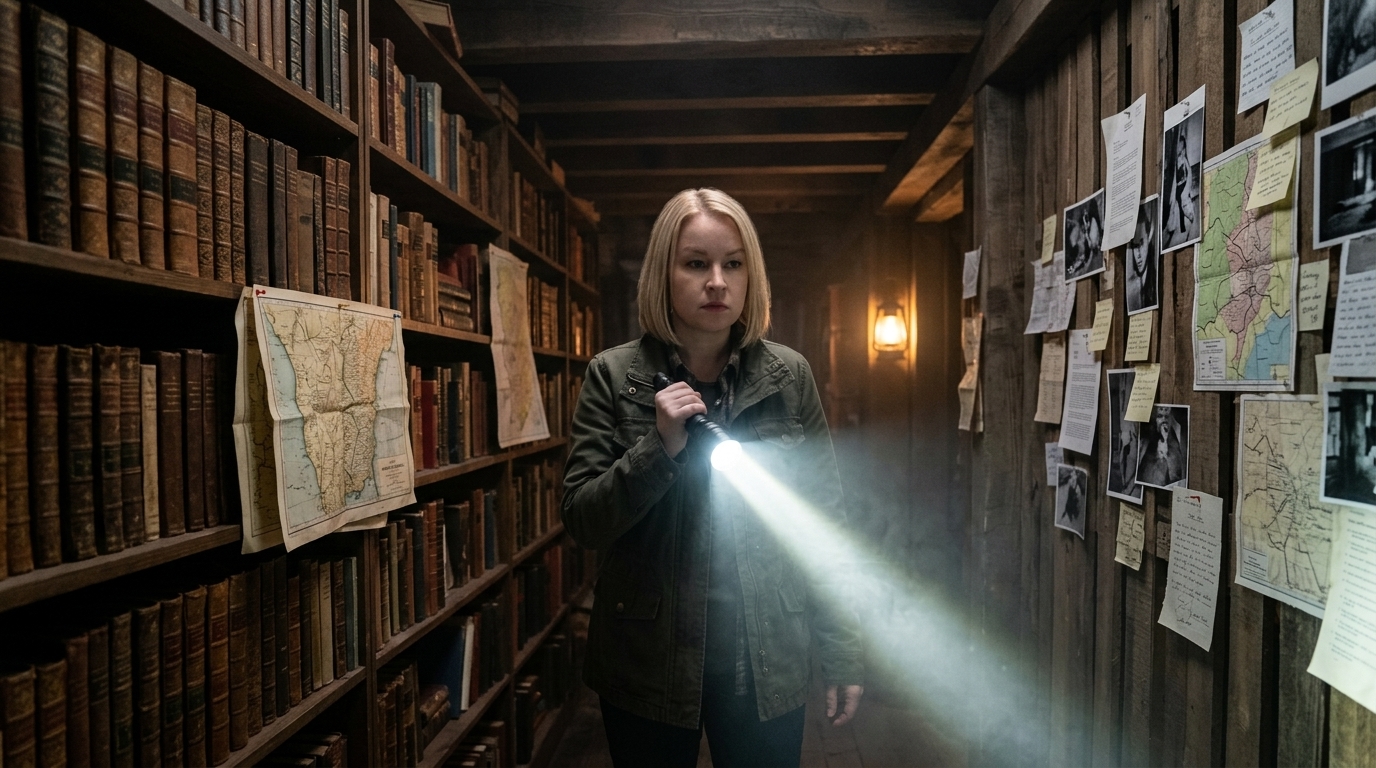
Art style: Realistic cinematic. A highly detailed, atmospheric, and immersive scene set within a narrow, claustrophobic, and deeply mysterious room that strongly resembles a secret, forgotten archive or an obsessive investigator's hidden lair. The composition is a carefully framed medium shot, centrally focusing on a woman standing rigidly in the middle of the tight space, holding a powerful flashlight. The lighting design is extremely dramatic, high-contrast, and deeply evocative. The primary and most aggressive light source is the intense, harsh, clinical white beam of the heavy tactical flashlight she grips firmly in her right hand. This beam cuts diagonally across the lower center of the frame, creating a striking, sharply defined volumetric light cone that is heavily populated with swirling, illuminated dust motes, giving the air a thick, palpable texture. This harsh, directional light creates deep, impenetrable, pitch-black shadows in the far corners, beneath the shelves, and among the ceiling beams. A secondary, much weaker, and highly contrasting warm ambient light emanates from a small, glowing lantern or wall sconce barely visible in the deep, out-of-focus background on the right side. This distant source casts a faint, flickering orange-yellow glow that subtly fights against the cool, bluish-grey shadows dominating the overall space. The left side of the frame is entirely dominated by a massive, floor-to-ceiling, sturdy wooden bookshelf constructed from dark, aged timber. The shelves are tightly packed, almost overflowing, with hundreds of heavy, antique books. These volumes feature heavily worn, textured leather spines in muted, somber shades of dark oxblood brown, deep forest green, navy blue, and charcoal black. Several books display faded, intricate gold tooling that barely catches the ambient light. Attached directly to the front edges of these shelves are several large, open books or atlases, their expansive pages facing the viewer. These open pages display intricate, vintage maps with faded, washed-out pastel colors, detailed coastlines, and archaic, elegant typography. The paper of these maps is heavily yellowed, deeply creased, stained with moisture, and shows signs of significant age, handling, and wear. The right side of the frame features a makeshift wall or partition constructed from rough, vertical wooden planks. This surface is almost entirely obscured by a chaotic, dense, and overlapping collage of pinned documents, loose papers, black-and-white photographs, and smaller, localized maps. The papers vary wildly in size, texture, and color, ranging from crisp white modern sheets to heavily aged, brittle parchment. A prominent, large map with intricate street lines and a large, bold reddish shape is pinned near the top right. Below it are scattered, erratic notes, some bearing visible, dense, frantic handwriting, alongside several small, vintage photographs depicting unidentified individuals. This chaotic arrangement suggests a frantic, obsessive, and ongoing investigation. In the lower right foreground, partially illuminated by the harsh edge of the flashlight's beam, rests a disorganized stack of large, closed books on a rough wooden surface, their pages uneven and covered in a fine layer of dust. The ceiling above is low, heavy, and oppressive, featuring thick, dark, exposed wooden beams that quickly recede into absolute shadows. The floor is entirely lost in darkness, adding to the feeling of a bottomless, secretive space. The overall mood is incredibly tense, secretive, and deeply enigmatic, evoking a profound sense of discovery, isolation, and hidden truths waiting to be uncovered in the dusty, forgotten, and oppressive atmosphere of the archive. ━━━━━━━━━━━━━━━━━━━━━━━━━━━━━━━━━━━━━━ FINAL STYLE ENFORCEMENT (this is the authoritative rendering directive — it overrides any style wording elsewhere in the prompt): Render this image entirely in "Realistic cinematic" style. Match the lighting grammar, material response, colour science, level of realism / stylisation, line weight, and shading model typical of "Realistic cinematic". Keep the subject, composition, camera angle, lighting direction, and colour palette from the description above — but EVERY surface, skin, fabric, material, and environmental element must be rendered in the "Realistic cinematic" idiom, not in any other medium.
Free to start · Generate videos and images with AI in seconds
More by Двойных Кристина
См. все →

More Gemini 3.1 Flash Image images
См. все →