Image - 2026-07-09 15:12
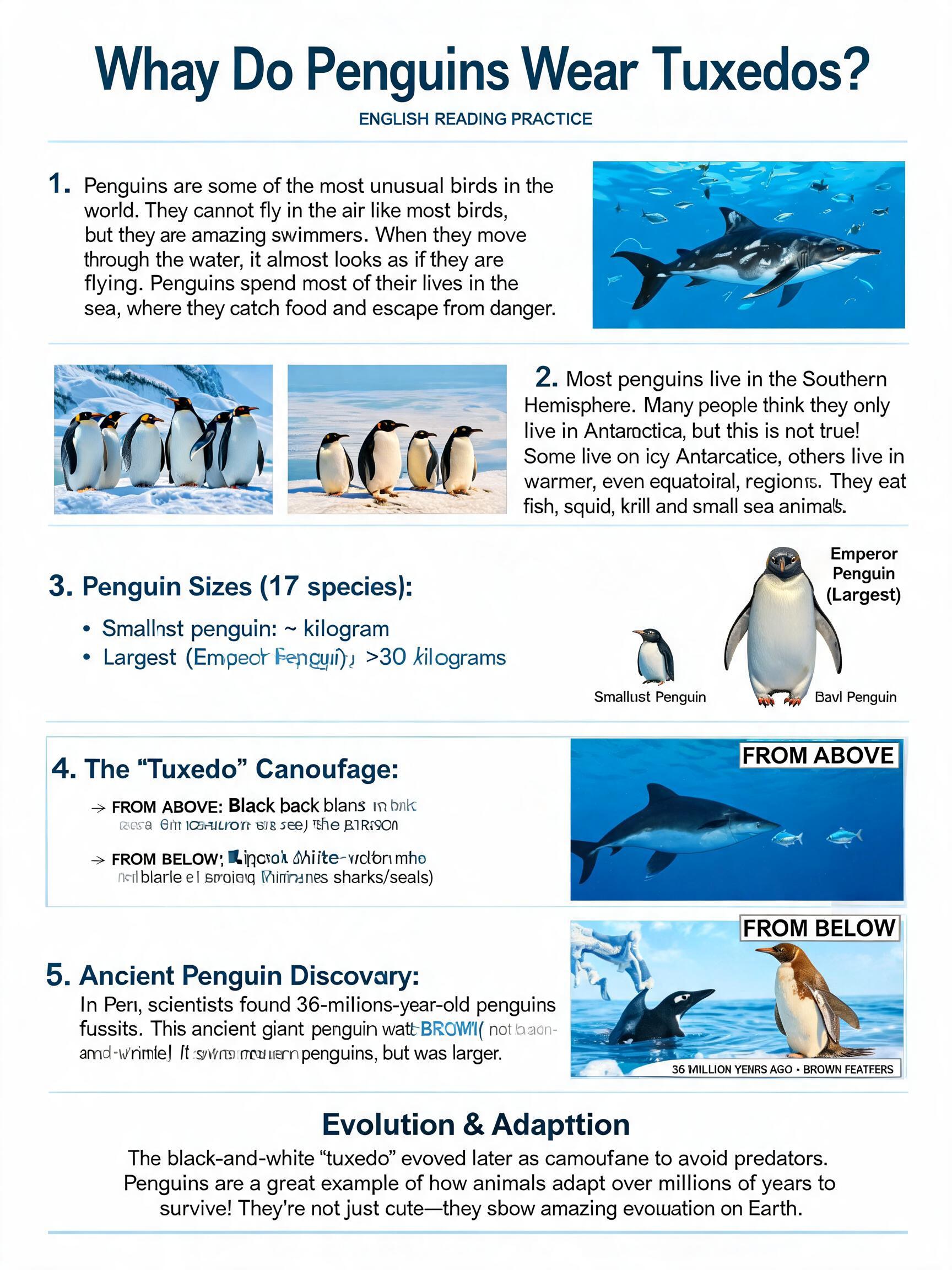
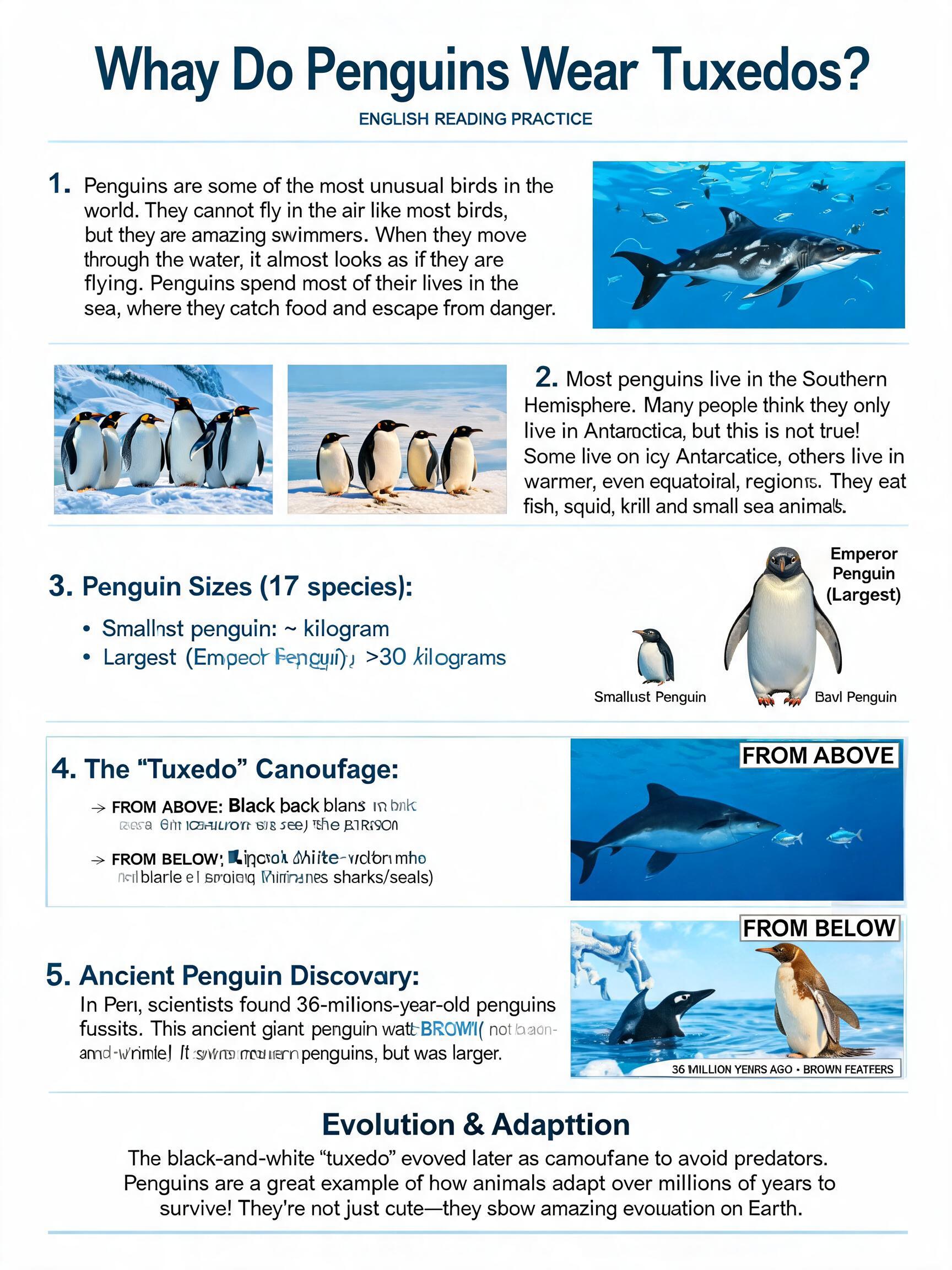
Сгенерируй картинку как статью для ученика, где нужно поместить этот текст для чтения и тренировки чтения на английском, выдели заголовок, добавь иллюстрации Why Do Penguins Wear Tuxedos? Penguins are some of the most unusual birds in the world. They cannot fly in the air like most birds, but they are amazing swimmers. When they move through the water, it almost looks as if they are flying. Penguins spend most of their lives in the sea, where they catch food and escape from danger. Most penguins live in the Southern Hemisphere. Many people think they only live in Antarctica, but this is not true. Some species live in very cold places covered with ice, while others live in warmer regions. There are even penguins that live close to the equator. They all eat seafood such as fish, squid, krill, and other small sea animals. Today there are 17 species of penguins. They are very different in size. The smallest penguin weighs only about one kilogram, while the largest, the Emperor Penguin, can weigh more than 30 kilograms. Even though they look different, all penguins have many features in common. Scientists study these similarities to understand how penguins have changed over millions of years. Penguins have many special adaptations that help them survive. Their thick feathers and layer of fat keep them warm in cold water. Some species travel many kilometres across ice between the ocean and the places where they raise their chicks. Penguins are also excellent hunters. Their strong beaks help them catch slippery fish, and they can stay underwater for a surprisingly long time without breathing. One of the most interesting things about penguins is their black-and-white colouring. From a distance, it looks as if they are wearing a tuxedo. This colouring is not only beautiful but also useful. It helps protect penguins from predators. When a seal or shark looks up from below, the penguin's white stomach blends with the bright surface of the water. When a predator looks down from above, the penguin's dark back is difficult to see against the dark ocean. This natural camouflage makes penguins harder to catch. Scientists are interested in how these features developed over time. They know that animals do not always change all at once. Different characteristics often appear at different times. For example, early human ancestors learned to walk on two legs long before they developed larger brains. Scientists call this idea mosaic evolution because different traits develop separately, like pieces of a mosaic picture. Researchers have asked the same question about penguins. Did they first become good swimmers? Did they start hunting fish before they developed their black-and-white feathers? Or did several changes happen together? These questions help scientists understand how evolution works. A very important discovery was made in Peru, where scientists found the fossils of an ancient giant penguin. This bird lived about 36 million years ago. The fossils were in very good condition, and even some feathers were preserved. By studying these feathers with powerful microscopes, scientists learned a great deal about the bird's appearance. The ancient penguin looked similar to modern penguins in many ways. It had feathers designed for swimming, and it probably hunted fish underwater just like penguins today. However, it was much larger than most living species. The biggest surprise was its colour. Scientists believe this ancient penguin was mostly brown instead of black and white. How can scientists know the colour of an animal that died millions of years ago? The answer is hidden inside the feathers. Tiny structures called melanosomes contain the pigment melanin, which gives feathers their colour. Different shapes and sizes of melanosomes produce different colours. By comparing fossil feathers with the feathers of living birds, scientists can make good guesses about the original colours of extinct animals. The ancient giant penguin had melanosomes that were different from those of modern penguins. This suggests that it probably had brown feathers instead of the famous black-and-white pattern. This means that the "tuxedo" appeared much later in penguin evolution. Scientists have several ideas about why this happened. One possibility is that the change happened by chance after millions of years. Another idea is that the new feather structure made swimming more efficient, and the colour change was simply a side effect. A third explanation is that black-and-white camouflage became useful only after new predators, such as seals and whales, appeared. These animals became better hunters, so penguins needed better protection. Although scientists still do not know the complete answer, they continue to study penguin fossils and modern birds. Every new discovery helps them understand how animals change over time and adapt to new environments. Penguins are not only cute animals. They are also an excellent example of evolution. Their bodies, feathers, swimming skills, and behaviour all show how living things can slowly change over millions of years. Even something as simple as their "tuxedo" tells an amazing story about survival, adaptation, and life on Earth.
Free to start · Generate videos and images with AI in seconds
More by Innocent Rigel
См. все →




More Seedream 5.0 images
См. все →