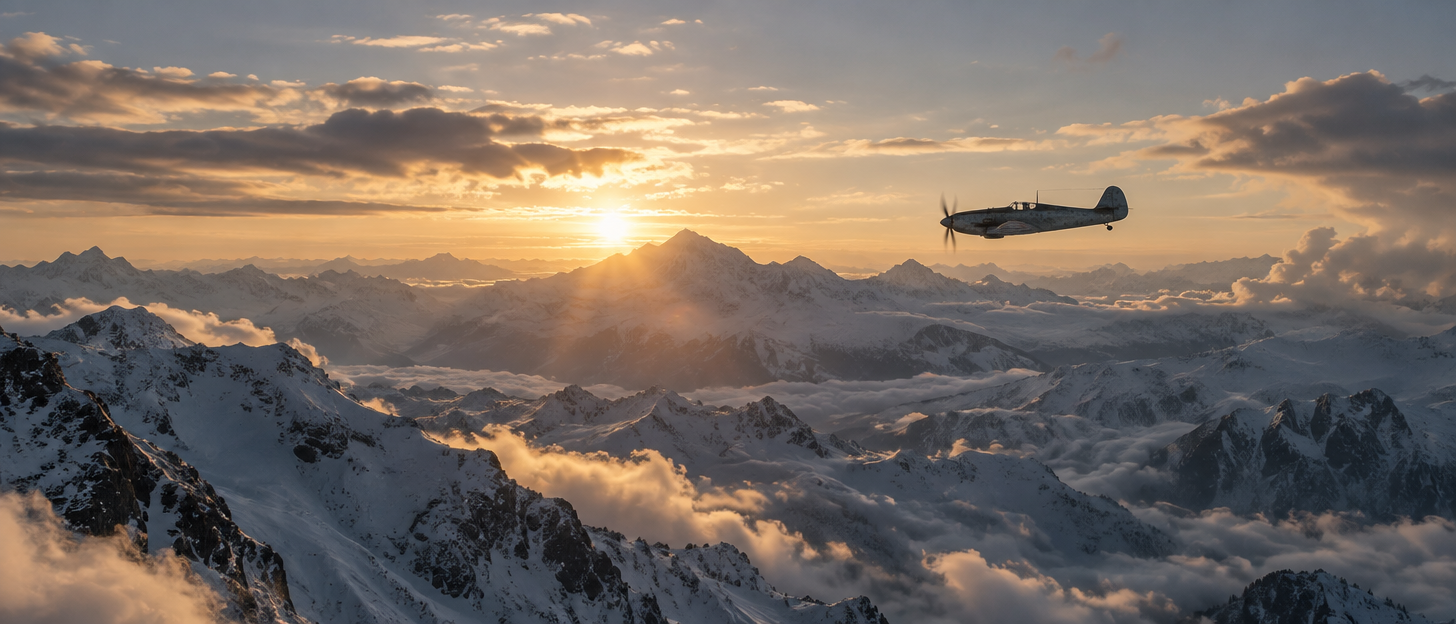
Image - 2026-09-27 22:07
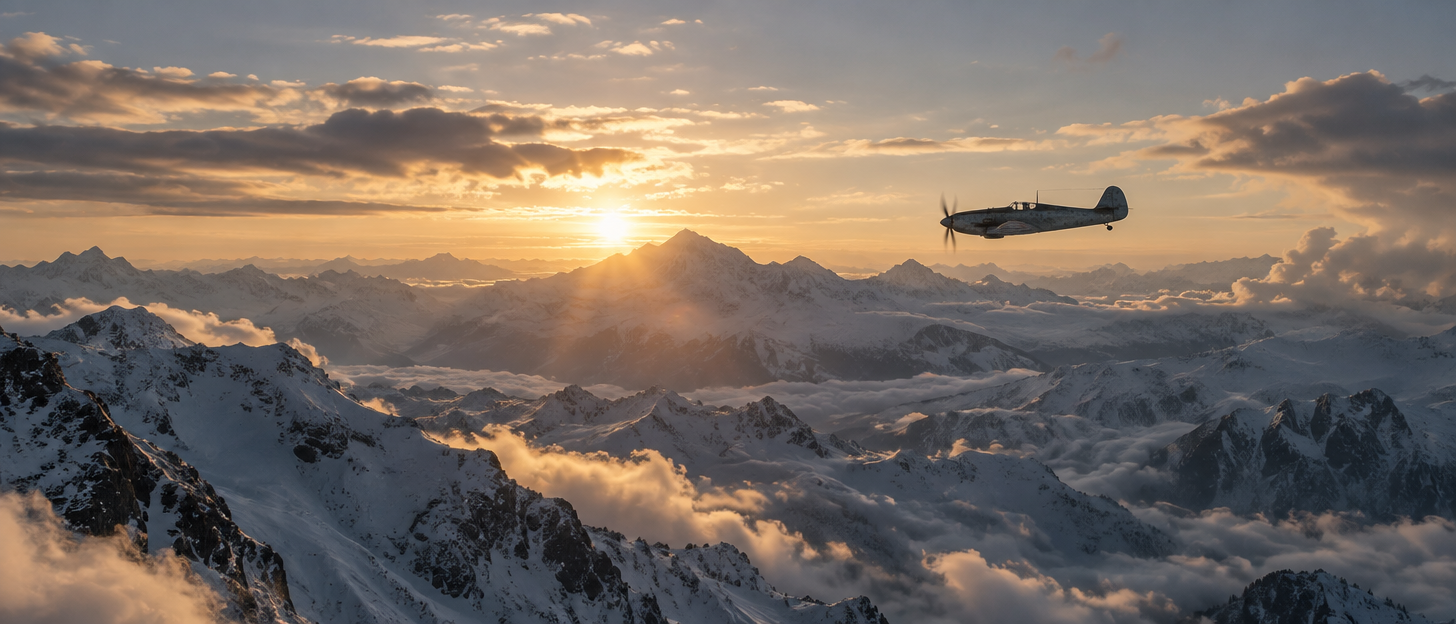
USE THE PROVIDED AIRCRAFT REFERENCE IMAGE AS THE SOLE AND ABSOLUTE VISUAL REFERENCE FOR THE AIRCRAFT. CRITICAL PRIORITY: The aircraft itself must be reproduced as accurately as physically possible from the supplied reference image. Do NOT redesign, reinterpret, modernize, stylize, simplify, or invent any part of the aircraft. AIRCRAFT — REFERENCE LOCK: Preserve the exact visual identity, proportions, geometry, silhouette, fuselage shape, nose shape, engine cowling, propeller, cockpit canopy, canopy framing, wings, wing thickness, wing roots, tailplane, vertical stabilizer, landing-gear geometry if visible, panel layout, surface construction, weathering, paint, colors, markings and all visible details exactly as shown in the reference. The aircraft must look like the SAME REAL AIRCRAFT photographed from a different distance and a strict side-profile camera position. Do not add any markings that are not present in the reference. Do not add roundels, insignia, symbols, text, labels, weapons, antennas, lights, camouflage patterns or decorative elements that are not clearly present in the supplied aircraft reference. Do not remove or alter existing markings from the reference. Do not change the aircraft type or its proportions. Do not make it look like another WWII aircraft. Do not reinterpret the aircraft based on generic historical aircraft knowledge. IMPORTANT: The supplied reference controls the aircraft. Everything outside the aircraft is newly constructed. COMPOSITION: Ultra-wide cinematic 21:9 composition. The aircraft is relatively small in frame and positioned in the RIGHT THIRD of the image, with substantial negative space extending toward the left side. The aircraft is flying clearly from RIGHT TO LEFT. Camera is positioned at a TRUE ORTHOGRAPHIC-LOOKING SIDE PROFILE relative to the aircraft: strict lateral profile, 90-degree side view, no three-quarter front angle, no three-quarter rear angle, no elevated top-down view, no dramatic aircraft banking, no visible opposite side, no exaggerated perspective distortion. The aircraft should read as a clean, recognizable silhouette and side profile against the environment. The camera is significantly farther away than in the previous generations. The aircraft occupies only a modest portion of the frame. The environment and enormous mountain landscape dominate the composition. The aircraft should feel distant, isolated and naturally embedded in the enormous landscape rather than presented as a hero product shot. ENVIRONMENT: A vast, extremely realistic high-altitude winter mountain range with enormous snow-covered alpine peaks extending deep into the distance. Massive layered mountain depth: foreground ridges, middle-distance peaks, far atmospheric mountains, deep valleys filled with soft cloud and mist. The mountains should feel geographically enormous and physically believable. Heavy winter atmosphere, but NOT a blizzard. Only a very small number of subtle airborne snow crystals visible near the camera. No dense particle effects. No artificial snow streaks covering the image. No fantasy particles. Natural thin mountain haze and fine atmospheric moisture create realistic depth separation between distant peaks. Large sculptural clouds and low cloud layers move through the valleys. Clouds should have natural photographic structure and physically believable atmospheric perspective. SUN: A low winter sun positioned much closer to the CENTER of the composition, slightly left of center. The aircraft is flying between the camera and the distant sun, so the sun is behind and slightly beyond the aircraft. The sunlight shines toward the camera through thin atmospheric haze and gaps between clouds and mountains. Natural backlighting and subtle rim light on the aircraft. The sun must feel physically present in the atmosphere, not like a glowing graphic effect. Controlled natural lens flare only: very subtle, optical, localized, realistic, not a large artificial flare, not colored CGI streaks, not excessive bloom. LIGHTING: Natural late-winter golden-hour light. Strong but realistic warm sunlight from behind the aircraft. Cool blue-gray shadows in the mountains. Warm highlights on cloud edges and snow. Natural atmospheric scattering. Preserve detailed shadow information. No crushed blacks. No HDR appearance. No excessive orange grading. No teal-and-orange commercial look. The aircraft should remain somewhat darker because it is backlit, but its surface details must still be naturally readable. PHOTOGRAPHIC REALISM: This must look like an actual photograph captured by a professional aerial cinematography camera. NOT CGI. NOT 3D rendering. NOT digital illustration. NOT concept art. NOT game-engine graphics. NOT AI-looking. NOT an advertising render. The image should have the subtle imperfections and optical characteristics of a real camera: natural atmospheric softness, real optical falloff, subtle sensor noise, natural micro-contrast, realistic highlight clipping, smooth highlight rolloff, physically plausible reflections, realistic motion blur, natural depth haze, slight optical imperfections. Do not make the image clinically sharp everywhere. Do not apply excessive artificial sharpening. Do not create plastic-looking surfaces. Do not create hyper-detailed AI texture. Do not make mountains look like matte paintings. CAMERA: Large-format professional digital cinema camera, large sensor, high dynamic range, natural cinematic tonal response. 24mm full-frame-equivalent cinema lens. The 24mm lens is used primarily to establish an enormous environmental perspective, while the aircraft remains relatively distant in the frame. Camera-to-aircraft distance is substantially increased. Long environmental separation between aircraft and camera. Camera is flying at approximately the same altitude as the aircraft. Camera movement is smooth and stable, like footage captured from a professional stabilized aerial camera platform. No drone-like extreme perspective. No action-camera distortion. No fisheye effect. No barrel distortion. No wide-angle stretching of the aircraft. Aperture approximately T4–T5.6: enough depth of field to preserve realistic mountain detail while maintaining subtle cinematic separation. Shutter approximately 1/48–1/96 sec depending on aircraft motion, producing restrained natural propeller and motion blur. ISO kept low enough to preserve clean shadow detail and realistic fine-grain sensor texture. Natural cinematic exposure with approximately 13–15 stops of usable dynamic range. White balance approximately 5200–6000K, adjusted naturally for the warm low sun. Color science similar to a high-end large-format cinema camera: neutral base, gentle highlight rolloff, subtle filmic color separation, restrained saturation, natural whites, rich but believable blacks. No LUT-heavy appearance. No excessive film grain. No fake anamorphic artifacts. LENS / OPTICS: Professional cinema prime lens. Clean modern optical rendering with subtle natural character. High micro-contrast without oversharpening. Smooth highlight rendering. Very subtle veiling flare when looking toward the sun. Natural chromatic behavior. No fake CGI lens effects. FOCUS: Aircraft is the primary photographic subject. Focus is stable and natural on the aircraft. Distant mountains gradually soften with atmospheric perspective rather than artificial blur. The depth separation should come primarily from real atmospheric perspective, distance, haze and scale — NOT aggressive computational depth-of-field. AIRCRAFT MOTION: Aircraft flies smoothly from RIGHT TO LEFT. Propeller shows natural rotational motion blur. Very subtle atmospheric motion around the aircraft. A tiny, physically plausible warm exhaust glow immediately behind the engine only if consistent with the reference aircraft's visible engine configuration. No large flames. No rocket exhaust. No glowing jet trail. No fantasy engine effects. COMPOSITIONAL FEEL: Extremely expensive high-end theatrical aviation cinematography. The image should communicate: enormous scale, cold altitude, winter, solitude, speed, natural danger, quietness, and cinematic grandeur. The aircraft is intentionally small relative to the environment. The mountains, sky, clouds and atmosphere occupy most of the frame. The visual hierarchy is: 1. enormous mountain environment 2. dramatic natural sunlight 3. aircraft silhouette and authentic physical details 4. subtle atmospheric motion REAL CAMERA IMPERFECTIONS: Very subtle natural sensor texture. Very subtle lens flare. Natural atmospheric diffusion. Very subtle motion blur. Natural exposure variation. No artificial sharpening halos. No AI texture. No plastic surfaces. No excessive clarity. No HDR halos. FINAL IMAGE: Photographically believable enough to pass as a frame extracted from an expensive real aerial cinema shoot. It should feel captured in-camera rather than generated. NO TEXT. NO CAPTIONS. NO UI. NO WATERMARK. NO TECHNICAL OVERLAYS. NO EXTRA AIRCRAFT. NO PEOPLE. NO BUILDINGS. NO MODERN OBJECTS. NO FANTASY ELEMENTS. MOST IMPORTANT: DO NOT CHANGE THE AIRCRAFT. The supplied reference image is authoritative for the aircraft's exact appearance. The new generation must change primarily the CAMERA DISTANCE, CAMERA POSITION, COMPOSITION and ENVIRONMENT — NOT the aircraft design. Aircraft remains an exact visual match to the supplied reference.
Free to start · Generate videos and images with AI in seconds
More from this creator


More Gpt Image 2.5 images
См. все →