Image - 2026-10-01 16:28
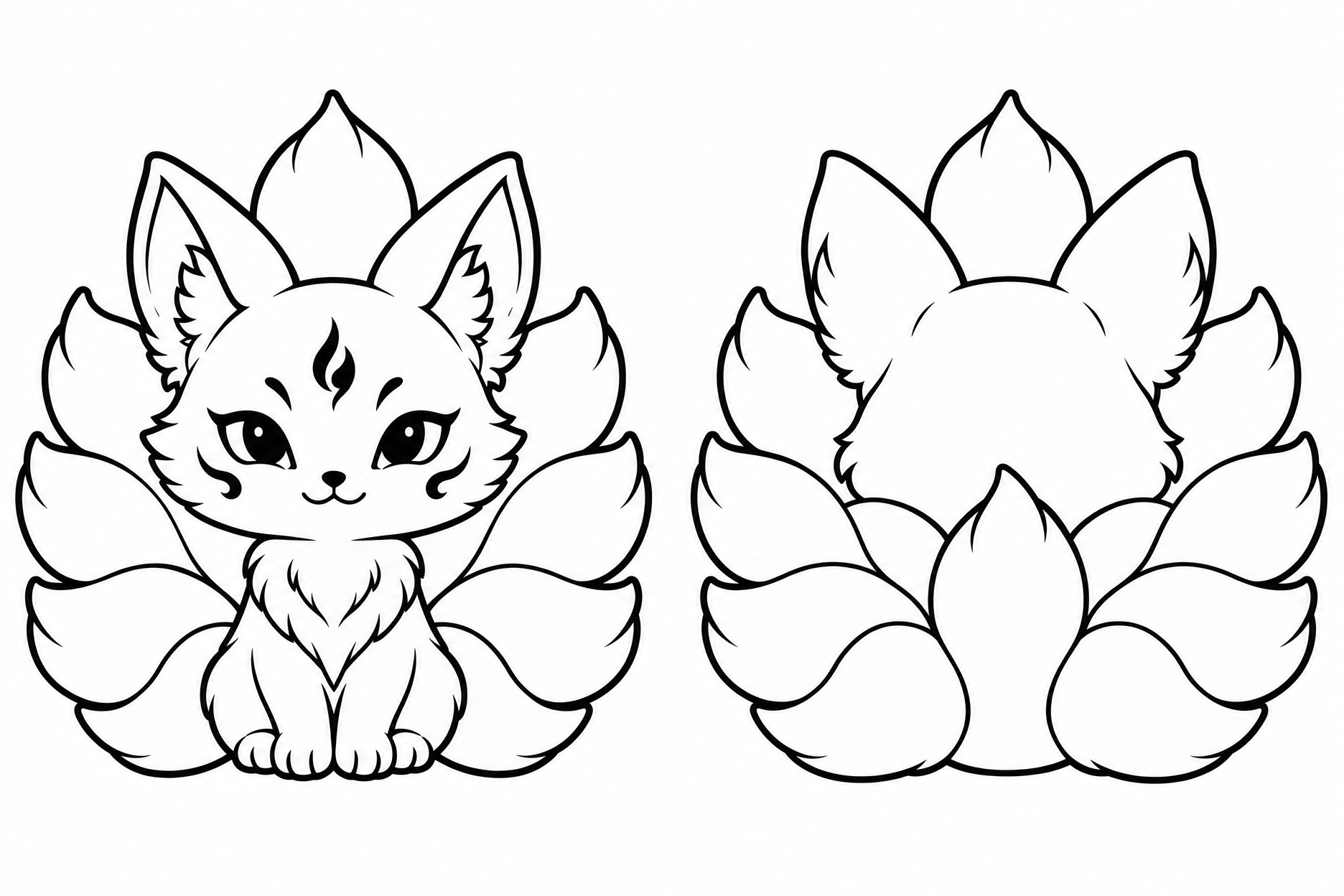
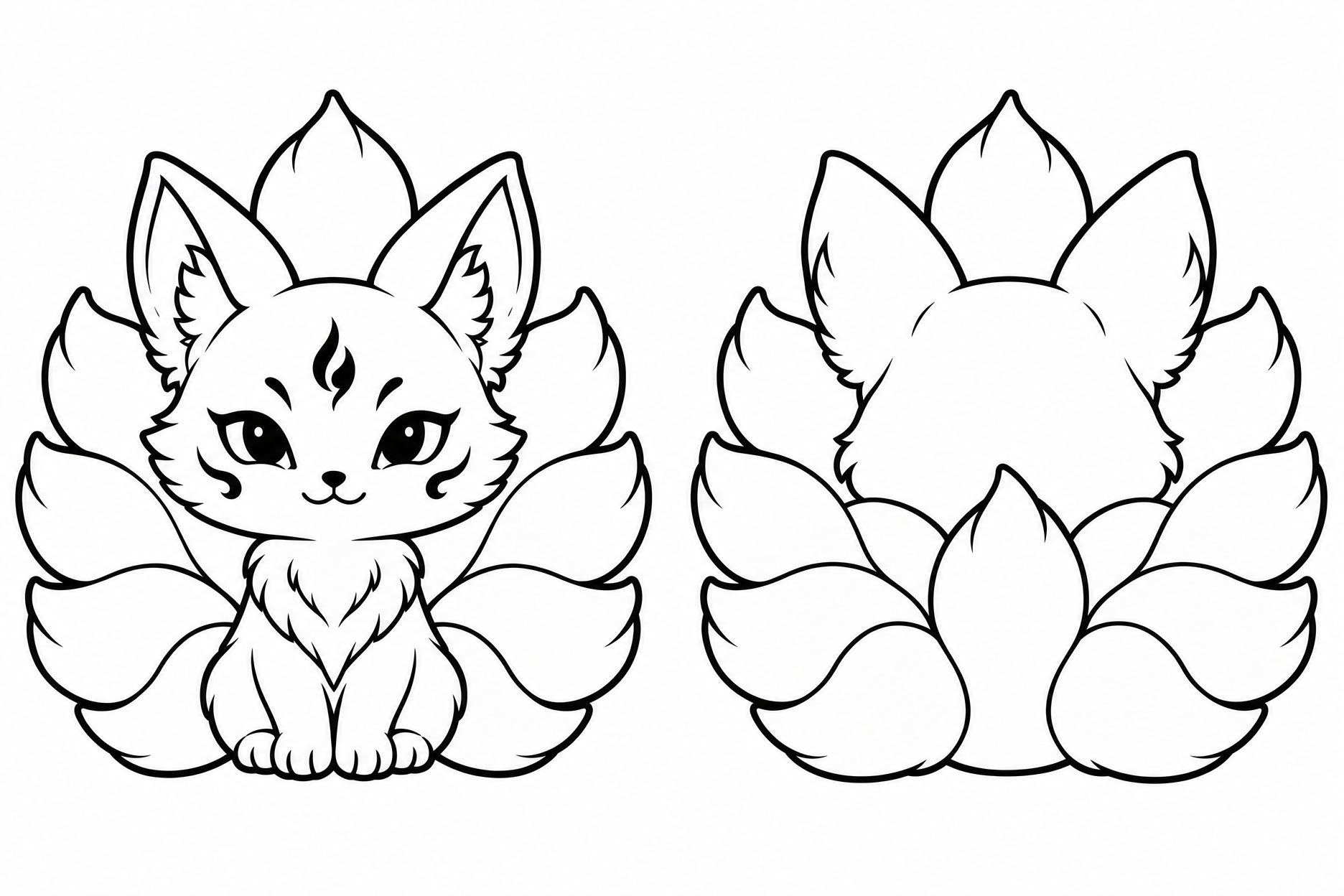
Create a premium black-and-white TWO-VIEW DESIGN SHEET of an enchanting chibi KITSUNE — a Japanese nine-tailed fox spirit — designed for engraving on both sides of ONE flat laser-cut charm. CANVAS AND COMPOSITION Use a landscape 3:2 aspect ratio at the highest available resolution. Show exactly TWO full-body illustrations side by side: LEFT: strictly straight-on FRONT view. RIGHT: strictly straight-on BACK view of the SAME kitsune. Center each figure in one half of the canvas. Both figures must have identical total height, width, scale, vertical alignment, and baseline. Leave generous white margins and a clear white gap between them. No dividing lines, panel borders, captions, or labels. CHARACTER DESIGN Design an exceptionally charming chibi fox spirit with an oversized rounded head, large upright triangular fox ears with softly rounded tips, fluffy rounded cheeks, a tiny compact body, and short chunky paws. Give the kitsune a gentle, mysterious personality: adorable, serene, and subtly magical rather than aggressive. Use a refined collectible-mascot aesthetic with beautiful proportions and elegant graphic shapes. Use a compact upright seated pose. Keep the head level, the body centered, and the front paws close together. The face should have graceful almond-shaped eyes, a tiny black fox nose, and a delicate, knowing smile. Add a small, simple flame-shaped forehead marking and one restrained curved marking on each cheek, all rendered in black. Keep these markings spacious and bold enough for small-format engraving. NINE-TAIL SILHOUETTE Arrange exactly NINE broad, fluffy fox tails in a compact, symmetrical fan BEHIND the body: — four tails fanning outward on the left; — four matching tails fanning outward on the right; — one central tail rising along the vertical centerline behind the head. The tails should form a harmonious, rounded, scalloped outer shape framing the fox. Keep the face and ears clearly readable. Use large, simplified, leaf-like tail shapes with gently rounded points. Clearly distinguish the nine tails through their broad tips and a few clean interior separation lines, not through thin gaps or intricate overlapping strands. All tails must merge broadly into a single connected silhouette with the body. Avoid narrow tail stems, fragile connections, detached elements, or enclosed cutout holes. Keep the fan compact rather than sprawling. ONE SHARED OUTER SILHOUETTE — HIGHEST PRIORITY These illustrations represent opposite faces of ONE physical cutout. Establish ONE bilaterally symmetrical exterior silhouette combining the fox and its nine-tail fan. Repeat that EXACT silhouette for both views. Change ONLY the interior engraving details. Both views must share identical: — overall tail-fan shape; — positions, sizes, and outlines of all nine tail tips; — ear-tip positions and any exposed ear contours; — head width and cheek contours; — body and paw outlines; — bottom edge, total height, and total width. When translated horizontally onto each other, the exterior outlines should coincide. Do not independently redesign, rearrange, rotate, or resize the tails for the rear view. Because the exterior is bilaterally symmetrical, the same physical outline must work for both sides. No perspective, three-quarter angles, head turns, tilted poses, or foreshortening. FRONT VIEW — LEFT Show the kitsune’s face, front-facing ear details, compact chest, and two small seated front paws. The fox’s head and body sit visually IN FRONT of the tail fan. Tail separation lines must stop wherever the head or body occludes them. Never draw tail lines through the face or torso. Use a simple chest-fluff shape indicated by two or three broad curves, not fine fur strokes. Keep the eyes expressive and readable, with no tiny highlights or elaborate lashes. Maintain white separation between the eyes, forehead marking, cheek markings, and muzzle. Represent the tail tips with a small number of clean curved boundary lines if needed. Do not fill the tails with dense black patterns. BACK VIEW — RIGHT Show the exact same kitsune directly from behind. Show the back of the head and rear surfaces of the ears, with no face or front-facing ear interiors. Because the tail fan is behind the body, it is now in the foreground of the rear view. Use clear, simplified overlap lines to show the nine tails gathering naturally around the lower back and rump. The tails may obscure much of the torso, while the back of the head remains legible. Keep the tail organization elegant and readable. Avoid a tangled knot of crossing lines at the tail roots. Suggest broad overlapping tail masses rather than nine narrow stems. Retain the same exterior tail-tip positions and shared cutting boundary as the front view. No eyes, nose, mouth, muzzle, smile, forehead emblem, facial markings, chest fluff, or front paws drawn as front-facing features on the back. LASER-CUT CONSTRUCTION Each figure must form ONE solid, connected shape suitable for cutting from flat sheet material. Use broad connections throughout the ears, cheeks, body, paws, and tail fan. Avoid sharp spikes, needle-like tips, narrow bridges, detached decorations, floating flames, or isolated pieces. Keep the outer boundary smooth, continuous, closed, and easy to trace. Use only shallow, rounded notches between adjacent tail lobes. No hanging hole, double outline, offset border, or additional decorative cutline. ENGRAVING GRAPHIC STYLE Pure black artwork on a pure white background. Use crisp, smooth, vector-like linework with confident curves and substantial, consistent strokes. The exterior outline may be slightly stronger than the interior lines. Keep all interior lines robust and clearly separated. Favor generous negative space and a few purposeful graphic details. Use small solid-black accents for the eyes, nose, and restrained facial markings. Keep the body and tails predominantly white. Avoid large black masses or dense ornamentation. Convey softness, charm, and mythical character through silhouette, proportions, expression, and elegant curves — NOT through shading or texture. OUTPUT Return only the finished coordinated front-and-back kitsune design sheet. No photograph, material simulation, engraved wood preview, metal charm mockup, laser-burn effect, or 3D product rendering. STRICT EXCLUSIONS No color, gray fills, gradients, shadows, lighting effects, halftones, hatching, stippling, realistic fur, sketchy strokes, or painterly effects. No clothing, jewelry, bells, ropes, masks, weapons, shrine scenery, floating flames, magical particles, props, ground line, typography, labels, logos, frames, or watermarks. No extra characters, additional views, cropped tails, mismatched outlines, different scales, or facial features on the rear view. FINAL CHECK Exactly TWO figures: FRONT on the LEFT, BACK on the RIGHT. Exactly NINE tails per view, arranged in the same symmetrical fan. Same kitsune, same pose, same scale, same baseline. Identical exterior silhouettes; only interior details and occlusion change. The front shows a charming fox face; the back shows no facial features. All tails belong to one structurally connected cutout. Clean, spacious linework suitable for small-format engraving. Priority order: shared silhouette accuracy, connected laser-cut construction, engraving readability, exceptional chibi kitsune design.
Free to start · Generate videos and images with AI in seconds
More by SHPENDE
См. все →
More Gpt Image 2.5 images
См. все →